greetings web-walker
welcome to my column
on the famous world wide web
if you enjoy it and want to discuss it
tell me at my bluesky thread:
[todo: put link to thread here]
or also copy this link to here and paste it
wherever u like to tell people about stuff
if you don't enjoy it
and you must express this,
you can drive a pipe
fifty feet below
the surface of the earth
and yell it in there
to the worms and devils
that need more of that
what with the pesticides
things of that nature
you know your bones know
i like games though
a world wide web log about games, though
✍ by: your pal lydelle buster ✍
LET'S PLAY A GAME: WIZARDRY GAIDEN IV
#1: re-learning how to crawl
June 2026
Too young in the earliest days of home computer gaming, I first experienced most 80s/early 90s CRPGs as secondhand titles on the hand-me-down computer I had in my bedroom. Awash in beautifully designed late 90s 16- and 32-bit console and PC games built with friendly UI for your average Win95/TiVo user, I still found myself intrigued and mystified by older, classic CRPGs. It helped that I shared a TV with my sister- so while it was her turn and she was fixated on Kirby, I'd hole up in my closet where I'd set up the family's old 80s PC
AD&D: Curse of the Azure Bonds is the first CRPG I completed, excruciatingly slowly; the game required a 286, but that didn't stop it from running on an 8088. It just took a second for a keypress to do anything. Like, a one-po-ta-to second, but, you could chain them in the keybuffer, fit nine keystrokes in three potatoes
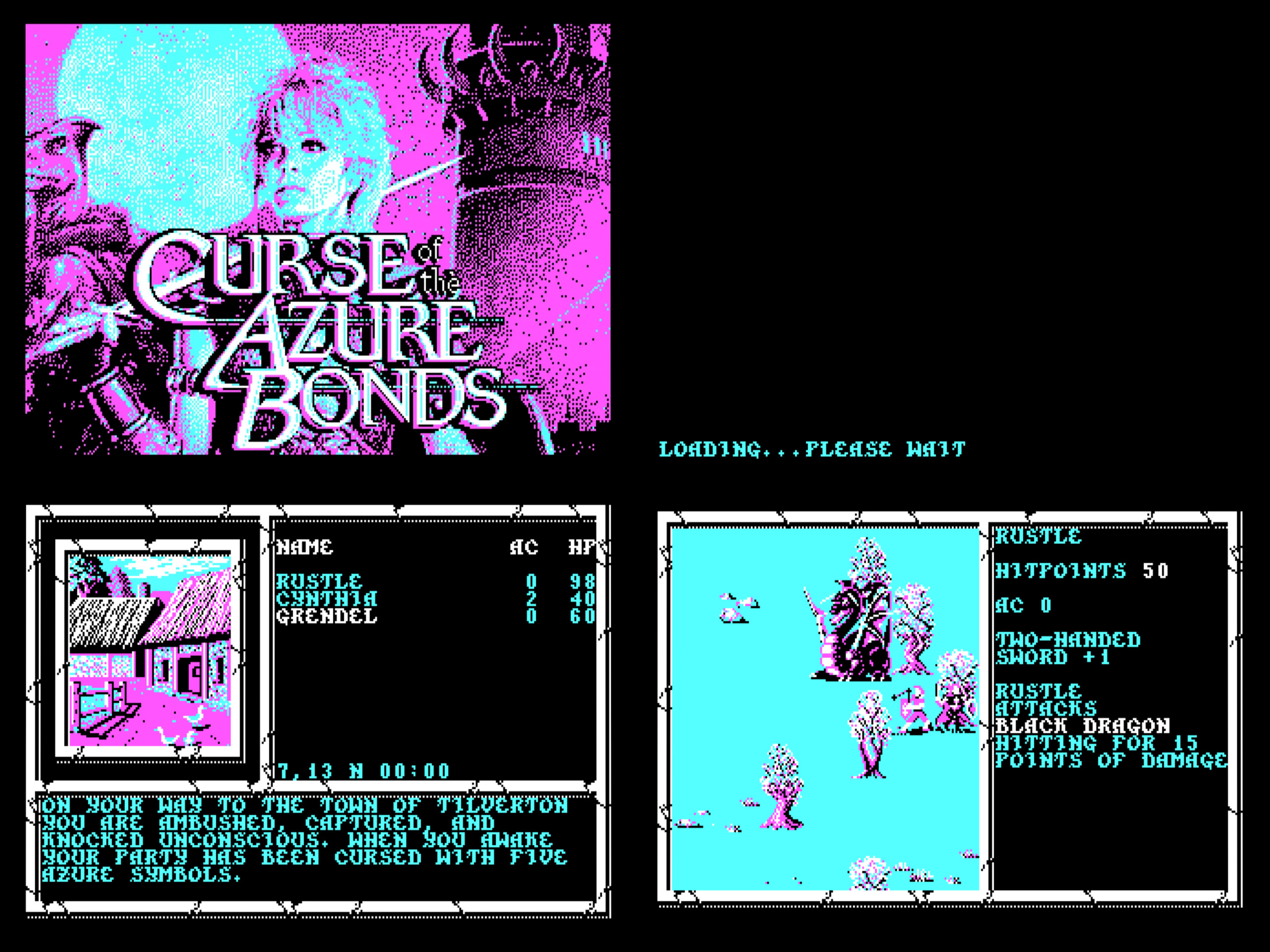
I played through the whole game like this, largely the top-right screen
I still wonder if sitting in the glow of that off a CRT did anything cool to my eye balls
With those input conditions, in 4-color CGA, I spent a preteen summer and then some playing through Azure Bonds. I had the manual, plus the hint book, and was getting into (2e) AD&D- it was a rewarding experience! In the one or two setpiece battles I could fit into an evening, ranged attacks spent minutes reaching their target. I'd spend that time thinking about my party of PCs, my lil guys, collecting inspiration for my tabletop game, or, just reading a book or magazine. It took ten times longer to play than as designed, I was a kid with focus and attention problems, and I finished it anyway
Why put myself through this? Why not just play a game designed to run on the 4.77 MHz 8088? Several great CRPGs existed on that platform, and by the mid/late 90s I could get many of them at the used computer store for half a lawn of mowing money. I just felt (unduly) intimidated by pre-Gold-Box CRPG titles, especially Wizardry
I first experienced Wizardry as a single-digit-aged kid, around third grade. I was primed mostly by the Dragon Warrior games on NES, a bit by Final Fantasy and Phantasy Star, when the elementary school recruited me to test a bunch of donated Apple //e disks. In return I got to play on the computer as much as I wanted for a couple weeks. I'd heard of Wizardry from magazines, recognized the label on the 5.25" floppy, figured out how to use the character disk in the second drive
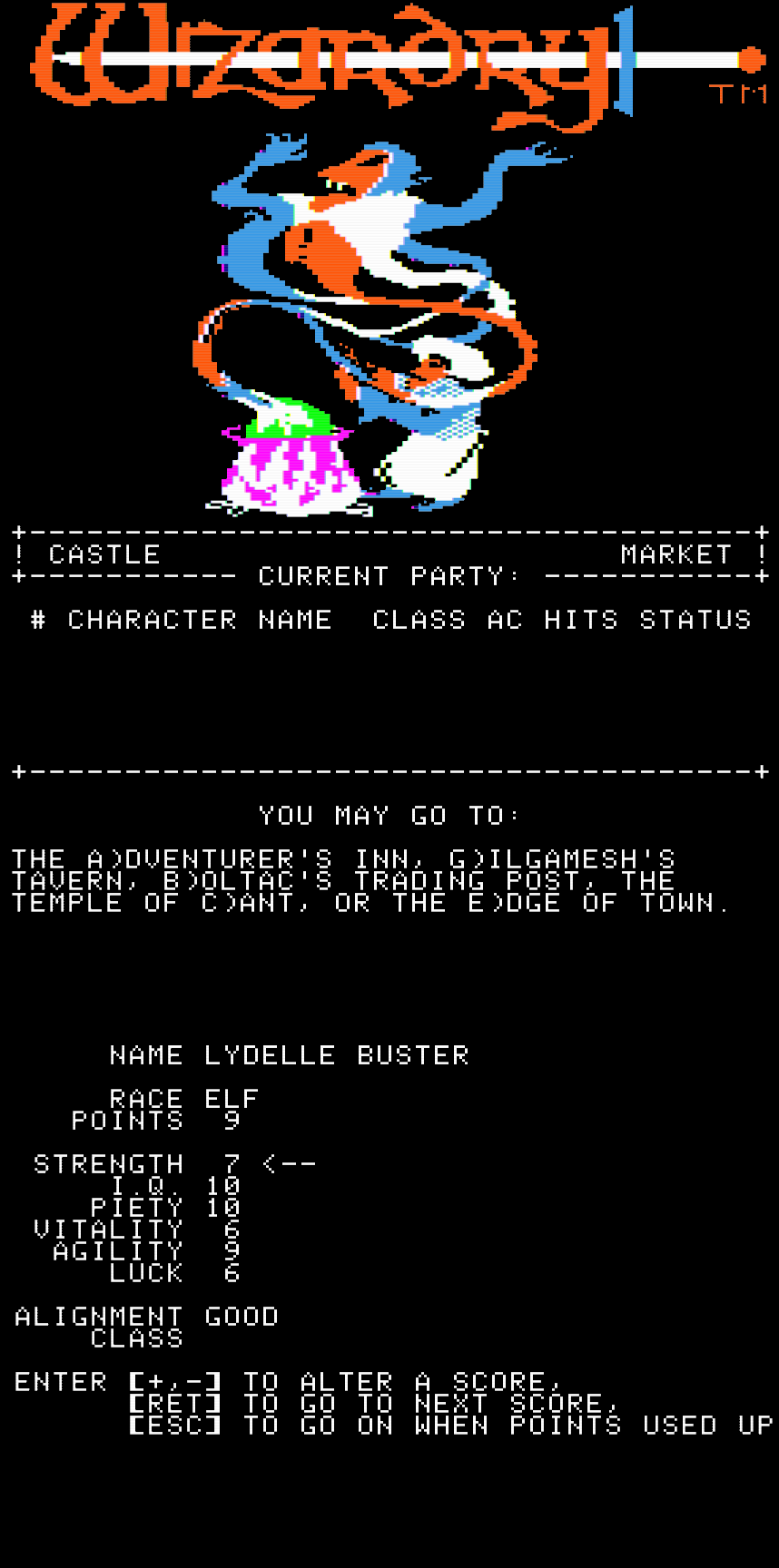
these screens were very different from the simpler NES RPGs i had been cutting my teeth on-
i remember spending a kid-eternity (maybe two hours) trying to work out how to enjoy this game
No players manual with this version, so I spent a whole indoor recess muddling through the entirely text-based town menus. I wasn't playing tabletop RPGs yet, so I wondered things like why removing armor made the AC number higher, or how you could tell which weapon had the highest ATK
Finally found my way to the dungeon, immediately got lost, experienced a TPK, all with someone else's characters. To start back where I was, I'd have to mount an expedition to recover the other PC's bodies. I had never experienced any setback so brutal in a video game before: It left me dazzled and completely intimidated.
Wizardry thereafter entrenched itself in my kid mind as the platonic example of a difficult RPG, as compared to such as Chrono Trigger or Fallout 2. My video game hours at home were spent on more contemporary 90s VGA/Console titles that had largely eschewed most expectations of mapping or taking exhaustive notes. Secrets were becoming more intricate at the same time that discussion about them was exploding on CompuServe, and later web, game FAQ groups
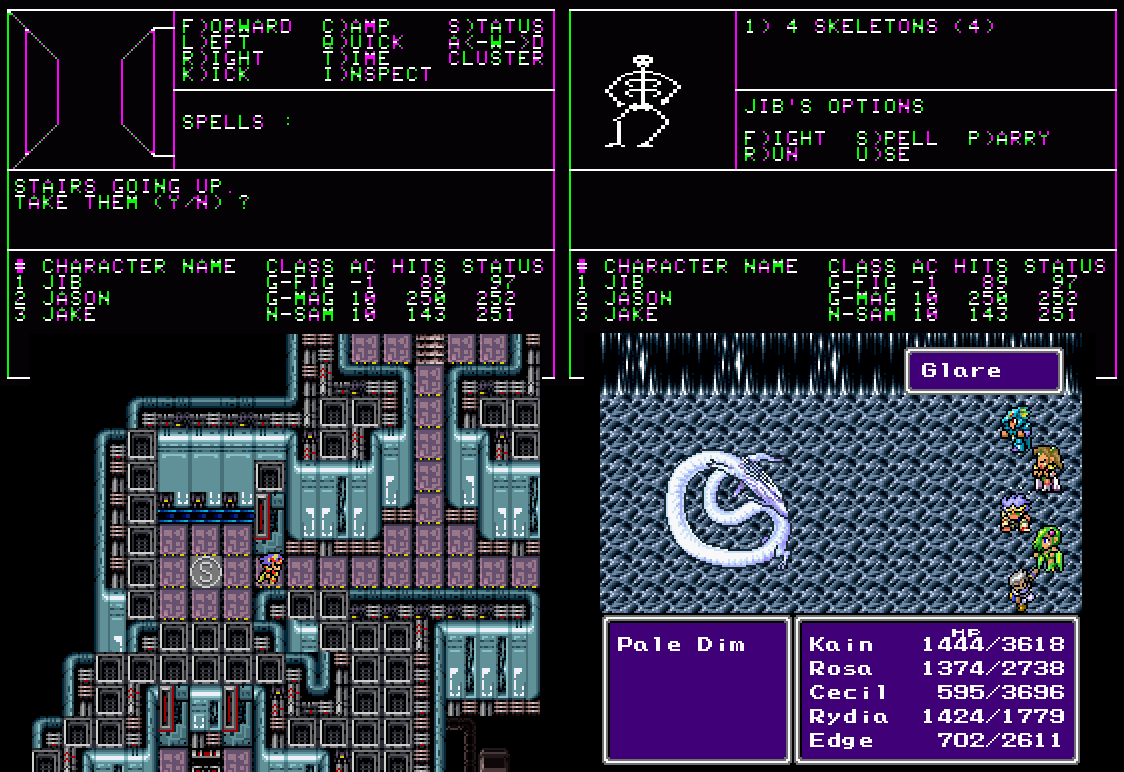
a brief comparison of an old 15-year-old game as compared to a recent 5-year-old game, back then
i was agog at SNES graphics as a kid, and i think you can see why
The idea of Wizardry's high difficulty remained dug in well into my adulthood, until the COVID-19 pandemic, when I decided to take on the first one: Proving Grounds of the Mad Overlord (what a title!), from 1979-80. And honestly? After learning to love grid paper mapping, I found it grindy, arbitrarily difficult, and like the back half was rushed. I had a blast anyway! It just ended up being a lot closer to Azure Bonds, in terms of difficulty, than I thought it would be
Instead of being a difficult puzzle of a game, it's just kind of tedious after playing the decades of games descended from it. Which is unsurprising! What's surprised me is that it's only a little bit rough, once you find the game loop. For one of the very few video game series having its roots in the 1970s, late as those 70s may be, it's a lot more playable that you might think. It's standing on the shoulders of the earliest university mainframe dungeon games, and the nascent tabletop RPG hobby, and not much else- but its own shoulders hold up almost every game you could call an RPG that came afterwards
I'm feeling drawn to older CRPGs again. I keep reading about the rich rewards under all the jank that comes with any artistic medium in its infancy, though, and I want to experience it. There are worlds here! Entire novel series worth of them, made obscure not through lack of quality, but difficulty of access. I've been eyeing the Magic Candle series in particular, with its rave reviews from people who were able to commit to it. It just also seems like a lot to take on all at once, especially off the back of recently playing gracefully-aging silver foxes like Morrowind and Fallout: New Vegas
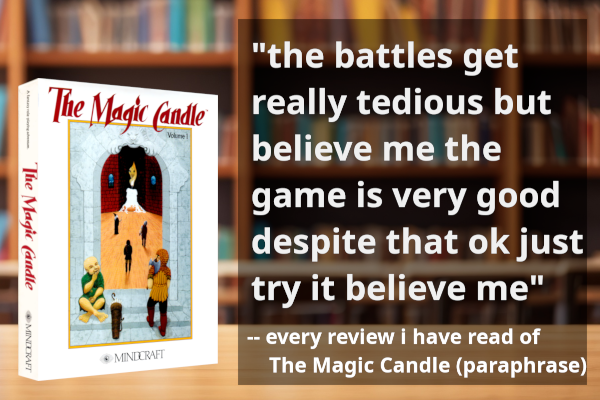
from Scorpia to the CRPG Addict, this is what they're all telling me
So: I have decided to play Wizardry Gaiden IV: Throb of the Demon's Heart again. While Wizardry in the US and Europe would change ruleset and even the nature of the game loop from Wiz 6 onward, the Gaiden series in Japan preserved in amber the basic playstyle and engine of the first five games. (if you like reading, and if you're this far in you must, check out The Digital Antiquarian's essays on this topic)
Released in 1996, Wizardry Gaiden IV has improved visuals as compared to the 8-bit computer versions, some QoL updates, incorporates new PC backgrounds and classes from Wizardry 6-8, and is built to play very comfortably on the SNES/Sony gamepad thats been standard for a young adult lifetime now. It's easy to emulate and, luckily, there's a English fan translation.
I've set up a very nice story here for why I'm playing this game and writing about it. That I learned it's not TURBO difficult, but does have enough of the old school CRPG trappings to help prepare me for the Magic Candles and Dark Hearts of Uukrul out there. That it's something I can ease into, along with one of the softer Ultimas. That story I have set up is very neat and has the weave of truth to it, but obscures what really draws me directly to Wizardry Gaiden IV: Making a Bunch of Little Blorbos
You can make like I think 30? different characters. In the original games on the Apple 2, you were limited in number only by how many party disks you had. The idea was, that a group of friends or roommates might have a copy of some Wizardry scenarios, and each have their own party roster disks.
This carries forward in many modern games inspired by Wizardry, which allow you to build a backbench of PCs for a dungeon crawl. It's very cool and fun in Wiz Gaiden IV, because with 11 backgrounds and several more classes, requiring two entire new schools of magic on top of the default arcane/divine, there's a lot to explore-
And ooooooh, I like making a buncha lil guys! of all genders and sexes! (the game says there's two, but it can go to hell, in that specific aspect!) I love having a lineup of imaginary paper dolls that go into dungeons and all know each other, forming friendships and rivalries in my brain, ideations of that nature. I'm blessed with a feeling of satisfaction thinking about that kind of thing; it's fun to make up a guy to get glad at. It's why these games exist, and why I'm excited to share the playthru with you
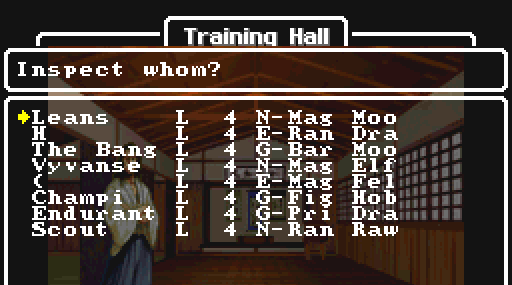
so much so that I've already made the first batch of guys,
I need a regimen; I can't just free-wheel this, or I end up playing just a normal game more or less. I've come up with a method I'm tenatively calling The Wiz, named not after the musical, but after the original first-season name of the Kansas City MLS team. The cowards later changed it to Wizards, and then further, to Sporting KC SC (more like boring sc etc), and so I'm specifying direct lineage from The Wiz (kc mls soccer team 1995-96) and not The Wiz (a musical? i havent seen the wiz (theatre)). It's important to me that everyone understands this
I've put together the rules of The Wiz (way to play some old CRPGs), here they are, direct from the main scratchpad for all this:
-
1) can't leave dungeon unless
- plot treasure acquired,
- puzzle solved
- or boss defeated
- or someone DIES
-
2) anyone who dies is replaced by
- existing benched PC, or,
- new random character
- note resurrection costs
- dead characters stay dead until party gp > 10x res
- first in, first out, strictly
There are a few more rules determining how characters are chosen for replacement, with a dice roll to determine if a new PC is created, or, a benched PC is used. These rules can also lead to the permanent deletion of dead PCs- which can pile up if a particularly expensive resurrection is clogging out the FIFO rez stack! I'll cover that procedure when we get to needing it
I think this will see me through, at least for the first part of the game! Now we can make our action dolls and explore the dungeons of Wizardry Gaiden 4: Throb of the Demon's Heart
Next time: personal anecdote preamble out of the way, Let's Actually Play